

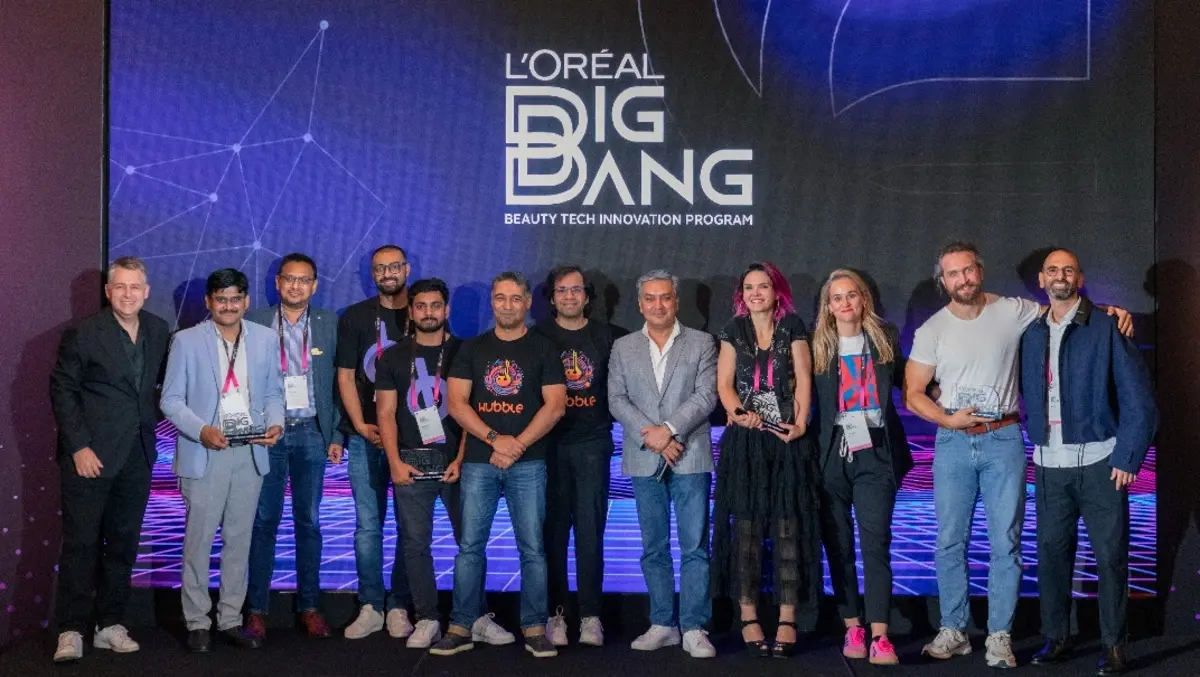
L'Oréal opens 2026 Big Bang beauty tech applications
Tue, 12th May 2026
L'Oréal has opened applications for its 2026 Big Bang Beauty Tech Innovation Program across the South Asia Pacific, Middle East and North Africa region. The programme is now in its third year.
The initiative targets startups working in five areas: Connected Brand Experience, Creators & Affiliates, AI-Powered Commerce, Science for Beauty and Innovation for Good. Winners will receive a funded commercial pilot with one of L'Oréal's brands, mentorship from senior leaders, and access to markets across the SAPMENA region.
This edition focuses on three shifts reshaping the beauty sector: AI-driven commerce, creator- and affiliate-led marketing models, and circular economy solutions. Seven startups from earlier cohorts have already progressed to commercial pilots.
The programme spans 35 markets in SAPMENA, stretching from New Zealand to Morocco and covering some of the world's fastest-growing consumer economies. It is open to startups from countries including the United Arab Emirates, Saudi Arabia, India, Singapore, Malaysia, Indonesia, Thailand, the Philippines, Vietnam, Australia and New Zealand.
For L'Oréal, the scheme is part of a broader effort to tap smaller technology companies for tools and services that can be tested within its beauty brands. Successful pilots in SAPMENA may also lead to wider work with L'Oréal beyond the region.
Regional focus
L'Oréal describes SAPMENA as a major base for beauty technology development, pointing to its large population and rapid growth in online shopping among younger consumers. The region is home to 3 billion people, or about 40% of the global population.
It also highlighted broader startup momentum across the region, citing figures from the 2025 Global Startup Ecosystem Index showing that Asia Pacific recorded the strongest annual growth worldwide. Singapore ranked fourth globally, while Saudi Arabia climbed to 38th place.
Within beauty, digital tools are increasingly shaping how products are marketed, sold and developed. L'Oréal cited NielsenIQ data showing that nearly half of consumers now receive beauty recommendations from generative AI.
Vismay Sharma, President of L'Oréal SAPMENA Zone, said the company sees the region as a testing ground for new beauty technology businesses. "SAPMENA is fast becoming a global epicentre for tech innovation. Millions of young, digitally native consumers are fuelling a rapid rise in digital commerce and redefining brand interaction. We believe this region is an important incubator for the future of beauty - a 'Silicon Valley' for Beauty Tech. As AI, the creator economy, and circularity reshape our industry, we are committed to discovering and nurturing the pioneers who will co-lead this transformation," Sharma said.
Past pilots
L'Oréal highlighted several companies from the 2025 cohort that have moved into pilot projects tied to specific business challenges in beauty marketing, materials and product development.
Without, an Indian materials science startup, is working on recycling multilayer plastics that have traditionally been difficult to process. Its founder said the programme helped turn recognition into a commercial test.
"Winning the Big Bang programme last year opened doors for us. This competition was not just about getting an award and recognition. We actually get the opportunity to do a pilot programme that can be scaled across markets," said Anish Malpani, Founder of Without.
Australian startup Heatseeker is testing tools for real-time customer intelligence that could help brands make faster market decisions. Its Chief Executive Officer and Co-Founder said the pilot had influenced the company's wider direction.
"Both Heatseeker and L'Oréal are obsessed with the same thing - delivering customer truth, fast - and that shared DNA has meant we've been able to design and validate a solution side-by-side with L'Oréal that is already shaping where Heatseeker goes globally. Partnering with L'Oréal is making us unstoppable," said O'Keeffe.
In the Middle East, Halo AI from the United Arab Emirates is working with L'Oréal on influencer discovery and brand matching. The company said the project addresses fragmentation in influencer marketing.
"Winning Big Bang is a signal that the agentic infrastructure we're building at Halo AI is meeting that moment, and I'm so excited to be building for that future with team L'Oréal," said Saad.
Another Indian company, Sravathi AI, is using an AI-based chemistry platform to identify active ingredients more quickly and with less waste. L'Oréal said the project links scientific discovery with sustainability goals.
"Through Big Bang, we gained access to L'Oréal's global and regional teams and partners - conversations that have been instrumental in shaping how we bring our platform to the beauty industry at scale," said Tipnis.
Singapore-based Wubble AI, which received a special mention in the 2025 cohort, has worked with L'Oréal on music tools designed to help ensure intellectual property compliance in brand activity.
"Being a part of the Big Bang competition has been a key milestone in the story of our young company. We have been fortunate to work with different L'Oréal teams since then, on two paid projects, and the experience has been absolutely invaluable in shaping and sharpening our product design and the user journey on our platform," said Roy.
L'Oréal operates more than 30 international brands across SAPMENA and 40 brands globally. In 2025, it reported sales of EUR €44.05 billion and said it employed more than 95,000 people worldwide.