

Rain Viewer adds radar freshness indicators for maps
Thu, 14th May 2026 (Yesterday)
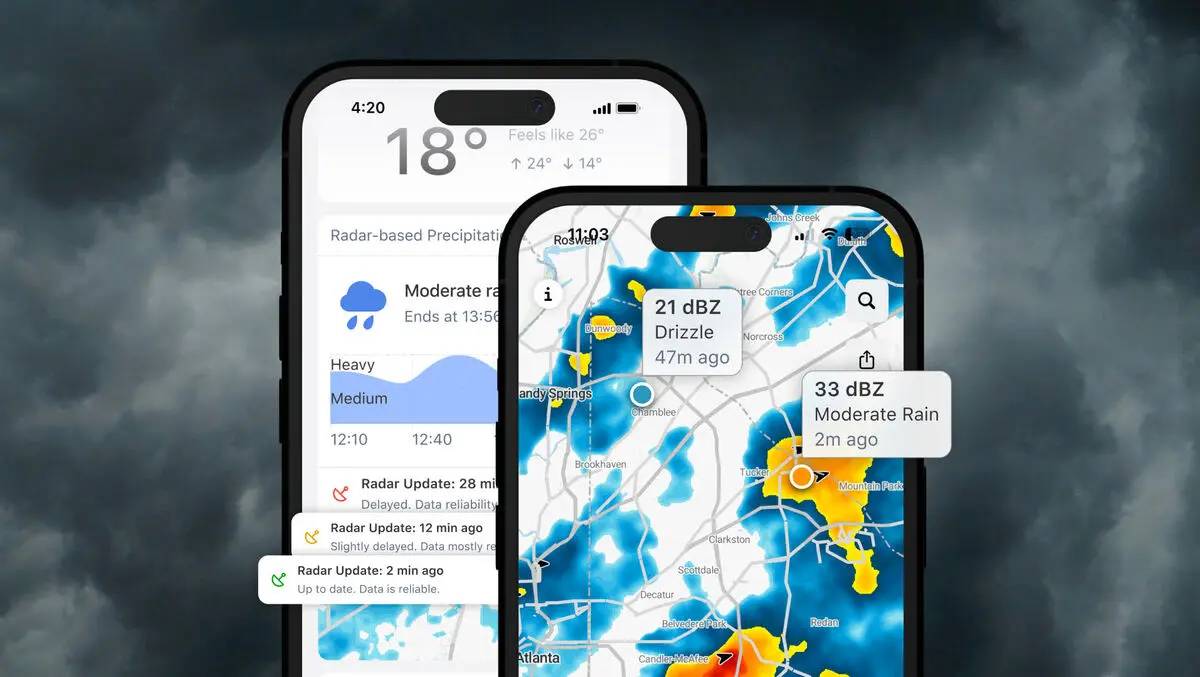
Rain Viewer has introduced per-location radar freshness indicators in its weather app, showing users how old the radar data is at a specific point on the map.
The update addresses a long-standing problem in weather apps: many show a single timestamp for an entire radar frame, even though data for different locations may have been captured at different times.
Radar imagery is not produced in real time. Individual weather stations scan on their own schedules, then data from multiple sources is combined, processed and delivered to mobile devices. The result is delays ranging from a few minutes to more than half an hour.
That means a single radar image can contain data of different ages across the map. A user checking rainfall over their home may be seeing data that is only a few minutes old, while a nearby area could be based on an older scan from another station.
The new system uses a colour code to show the age and reliability of data for each saved location. Green marks scans up to 10 minutes old, yellow covers data between 10 and 20 minutes old, red flags scans between 20 and 60 minutes old, and grey indicates no radar coverage, with satellite imagery shown instead.
Users can also tap any point on the map to see the precise scan age for that location. As a result, two nearby points may show different freshness ratings if they rely on separate radar stations with different update cycles.
Rain Viewer has also changed how it displays historical imagery. Older radar frames now show an absolute timestamp rather than a relative label such as "X minutes ago", which can become misleading when users review much earlier periods.
Latency issue
The change highlights a broader issue in weather services over the meaning of labels such as LIVE. In many apps, including Rain Viewer, the label means the app is fetching the latest available radar frame as quickly as possible, not that the underlying data is current to the minute.
Rain Viewer said the full radar delivery chain usually adds eight to 15 minutes of latency under normal conditions. Stations scan, upload data, and pass it through processing and distribution systems before it appears on a handset.
This can create a mismatch between what users think a timestamp means and what the imagery actually shows. Rain Viewer argued that users often place more confidence in the display than the underlying network can support, especially when the interface suggests immediacy.
The infrastructure behind the feature has been operating inside Rain Viewer's systems for two years. Known internally as Timing Map, it tracks scan age at pixel level across a composite radar map built from more than 1,200 stations worldwide.
According to the company, the system reads the alpha channel of each radar frame, which decreases as the scan gets older. That meant Rain Viewer did not need to change the data format or build an additional pipeline to expose freshness information to users.
Commercial split
The feature is being rolled out with different levels of access by product tier. Forecast-screen freshness indicators for saved places such as home, work or custom pins are available to Rain Viewer PRO users on iOS and Android, while free users can still see radar scan age by tapping points on the map.
Rain Viewer acknowledged a potential commercial risk in making data delays more visible. A yellow warning about slightly delayed radar may appear less reassuring than a rival app showing a simpler LIVE badge over comparable underlying data.
The company said it chose to expose the information because users were already noticing inconsistencies between the map and conditions on the ground. Its position is that hiding delays does not remove the problem, but instead leaves users without enough context to judge what they are seeing.
"We've always known the exact freshness of every pixel on our map. Now our users know it too. We'd rather show a yellow indicator and earn your trust than hide a delay behind a 'LIVE' badge," said Oleksii Schastlyvyi, founder of Rain Viewer.
Rain Viewer said roughly half the radar stations in its network update every five minutes, while the rest refresh every 10 to 15 minutes or less regularly.